Connecting on Two Airlines: Whose Carry-On Rules Apply?
One ticket or two, codeshare or self-transfer: which airline's carry-on size and weight rules you follow on a connection, and how to pack for the strictest leg.
You booked a trip with two airlines on it. Maybe a long-haul on a big full-service airline, then a short hop on a low-cost one. Or a ticket sold by one airline but flown by another. Now the question: whose carry-on rules do you follow?
The short version, and the one that saves the most money: your bag has to pass the rules of every airline that actually flies you. The airline that sold you the ticket decides a lot about checked bags. But at the gate, the bag in your hand gets judged by whoever operates that plane.
So pack for the strictest leg.
Short version: separate tickets mean each airline's rules apply on its own flight, full stop. On one ticket, checked-bag allowances usually follow one airline for the whole trip, but carry-on size and weight still get enforced by the airline operating each flight. Check every leg in the trip checker and pack to the smallest result.
One ticket vs separate tickets
This is the first thing to figure out, because the answer is completely different.
One ticket (one booking, one confirmation code for the whole trip). The airlines have an agreement to carry you through. Your checked bag is usually tagged all the way to your final stop, and if the first flight is late and you miss the second, the airline has to get you there. Baggage allowances get worked out under a set of "which airline's rules win" rules (more on that below).
Separate tickets (two bookings, often one cheap airline plus another). Each airline treats you as a brand-new passenger. You collect any checked bags, go back to check-in, maybe clear passport control, and go through security again. The second airline doesn't care what the first one let you bring. If your bag is fine on airline A and over the limit on airline B, you pay airline B's fee, usually at the airport price.
Booking sites sometimes sell these as "self-transfer" or "self-connecting" trips. They look like one trip in the search results. They aren't.
What the regulators say about one-ticket trips
For checked bags there's an actual system. IATA, the airline industry body, has a rule called Resolution 302 that picks a "most significant carrier" for trips mixing several airlines, and that airline's checked-bag allowance and fees apply to the whole journey.
The US and Canada have their own versions:
- United States. Under a federal rule, for trips that start or end in the US, airlines must apply the baggage allowances and fees from the start of your itinerary all the way through. On codeshares, the marketing airline's rules apply where they differ from the operating airline's (14 CFR 399.87).
- Canada. The Canadian Transportation Agency says the airline whose code is on the first flight of your ticket picks the rules, either its own or the most significant carrier's. But it also says plainly that each operating airline applies its own carry-on allowance on its own flights, because planes and bins are different sizes (CTA interpretation note).
That Canadian note is the clearest official statement of what happens in real life everywhere. Checked bags follow one set of rules. Carry-on bags meet a gate agent from the airline flying the plane, with that airline's sizer and sometimes that airline's scale.
Your fare still matters, though. If you bought a basic fare that doesn't include a full-size carry-on, a partner operating one leg won't magically give you one.
Codeshares: marketing vs operating airline
A codeshare is one flight sold under two or more airline codes. Your ticket might say Air Canada, but the small print says "operated by United Express". Or Qantas, "operated by Jetstar".
- The marketing airline is the one whose flight number you bought.
- The operating airline is the one whose crew, plane and gate staff you'll actually meet.
When travelers ask on Reddit which rules apply to a codeshare, the answer that keeps coming back is the same: for carry-on, follow the operating airline. That matches the CTA's position above. The operating airline knows its own bins, its own regional jets and its own sizers.
Where to find the operator: it's printed on the booking ("operated by..."), in the airline app, and on the boarding pass. Look before you pack, not at the gate.
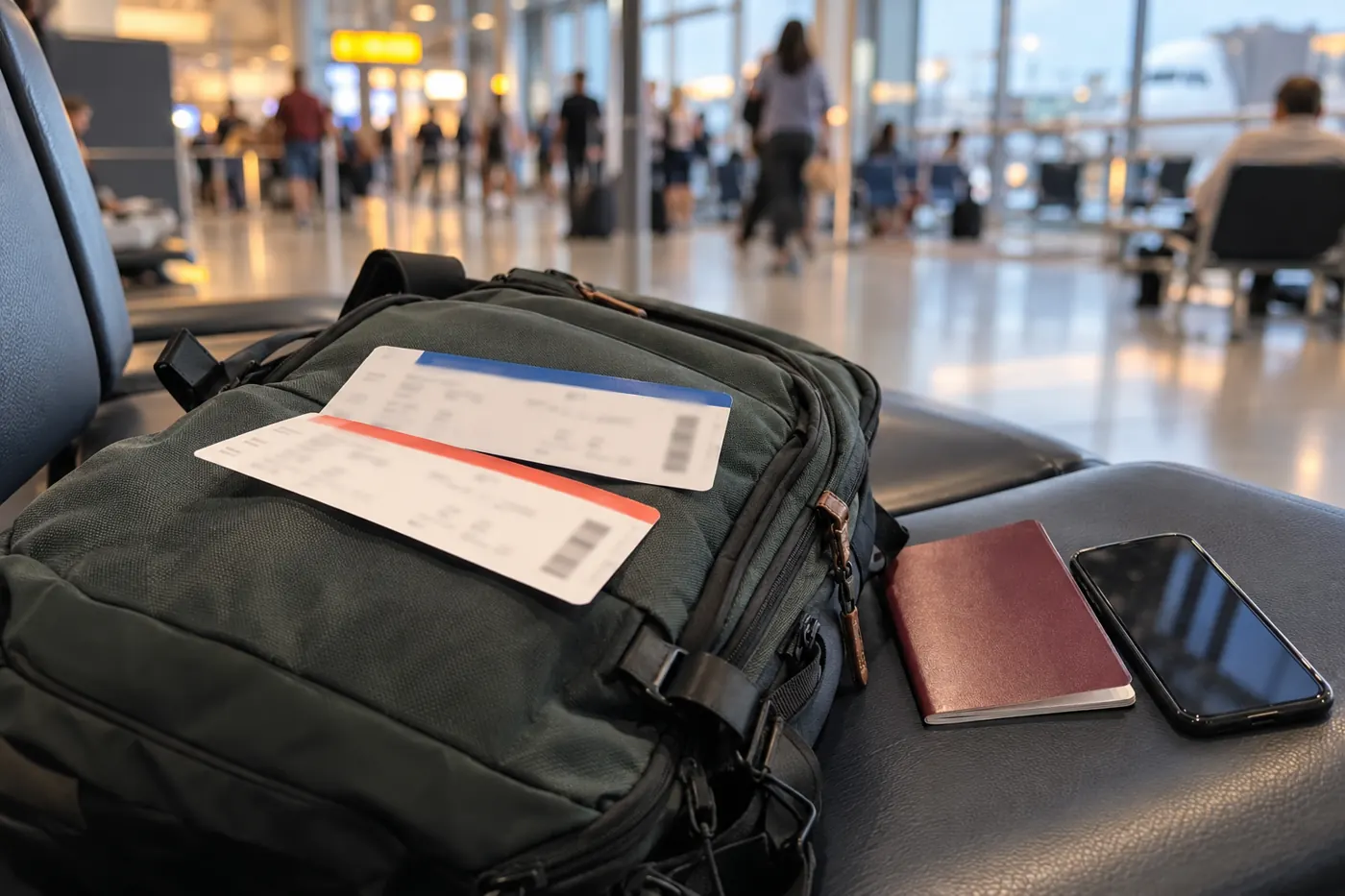
The classic trap: the long-haul is generous, the next leg isn't
Here's how it usually goes wrong. You fly a big airline across an ocean, with a decent checked allowance and a carry-on nobody weighs. Then you connect onto a low-cost or regional airline for the last bit, and suddenly there's a 7 kg limit, a smaller sizer, or no free overhead bag at all.
A few combinations that catch people:
- US airline, then a 7 kg airline in Asia or Australia. Most big US airlines don't publish a carry-on weight limit. Emirates, Singapore Airlines and Qantas (on international flights) allow 7 kg in economy. AirAsia allows 7 kg total for your carry-on and personal item together. A roller that sailed through in Chicago can be 3 kg over at the gate in Kuala Lumpur.
- Long-haul into Europe, then a budget hop. On Ryanair the cheapest fare includes only a small under-seat bag. A 10 kg overhead bag needs Priority. On Lufthansa, Economy Basic on short and medium-haul flights doesn't include a cabin bag in the overhead bin.
- Codeshare onto a regional or low-cost partner. The ticket shows the big airline's flight number, the plane is a smaller partner's, and its weight limit or bin space is tighter.
Here's how the limits look across the airlines we track in Asia:
| Airline | Country | Size limit | Weight | Carry-on |
|---|---|---|---|---|
| AirAsia | Malaysia | 56 x 36 x 23 cm about 22 x 14.2 x 9.1 in | 7 kg (15 lb) | Included |
| Vietjet Air | Vietnam | 56 x 36 x 23 cm about 22 x 14.2 x 9.1 in | 7 kg (15 lb) | Included |
| Vietnam Airlines | Vietnam | 56 x 36 x 23 cm about 22 x 14.2 x 9.1 in | — | Included |
| ANA (All Nippon Airways) | Japan | 55 x 40 x 25 cm about 21.7 x 15.7 x 9.8 in | 10 kg (22 lb) | Included |
| Japan Airlines (JAL) | Japan | 55 x 40 x 25 cm about 21.7 x 15.7 x 9.8 in | 10 kg (22 lb) | Included |
| Singapore Airlines | Singapore | 115 cm total 45.3 in total | 7 kg (15 lb) | Included |
And in Europe:
| Airline | Country | Size limit | Weight | Carry-on |
|---|---|---|---|---|
| Ryanair | Ireland | 55 x 40 x 20 cm about 21.7 x 15.7 x 7.9 in | 10 kg (22 lb) | Paid extra |
| Vueling | Spain | 55 x 40 x 20 cm about 21.7 x 15.7 x 7.9 in | 10 kg (22 lb) | Depends on fare |
| Air France | France | 21.7 x 13.8 x 9.9 in 55 x 35 x 25 cm | 26 lb (12 kg) | Depends on fare |
| KLM | Netherlands | 55 x 35 x 25 cm about 21.7 x 13.8 x 9.8 in | 12 kg (26 lb) | Included |
| Lufthansa | Germany | 55 x 40 x 23 cm about 21.7 x 15.7 x 9.1 in | 8 kg (18 lb) | Included |
| Wizz Air | Hungary | 55 x 40 x 23 cm about 21.7 x 15.7 x 9.1 in | 10 kg (22 lb) | Paid extra |
| Turkish Airlines | Turkey | 55 x 40 x 23 cm about 21.7 x 15.7 x 9.1 in | 8 kg (18 lb) | Included |
| Aer Lingus | Ireland | 21.5 x 15.5 x 9.5 in 55 x 40 x 24 cm | 22 lb (10 kg) | Depends on fare |
| Iberia | Spain | 56 x 40 x 25 cm about 22 x 15.7 x 9.8 in | 10 kg (22 lb) | Included |
| British Airways | United Kingdom | 22 x 18 x 10 in 56 x 45 x 25 cm | — | Included |
| Jet2 | United Kingdom | 56 x 45 x 25 cm about 22 x 17.7 x 9.8 in | 10 kg (22 lb) | Included |
| easyJet | United Kingdom | 56 x 45 x 25 cm about 22 x 17.7 x 9.8 in | — | Paid extra |
The big one people miss is weight. Size is easy to eyeball. Weight isn't, and on a lot of airlines outside North America the bag gets weighed at check-in or even at the boarding gate. Travelers flying out of Australia in particular say their carry-on gets weighed on almost every flight, full-service or not.
Self-transfer: what actually happens on the ground
If you're on separate tickets, picture the connection as two trips that happen to meet at an airport.
- You land, and if you had a checked bag, you go to baggage claim.
- You may need to pass immigration, even just to get back to the departure hall.
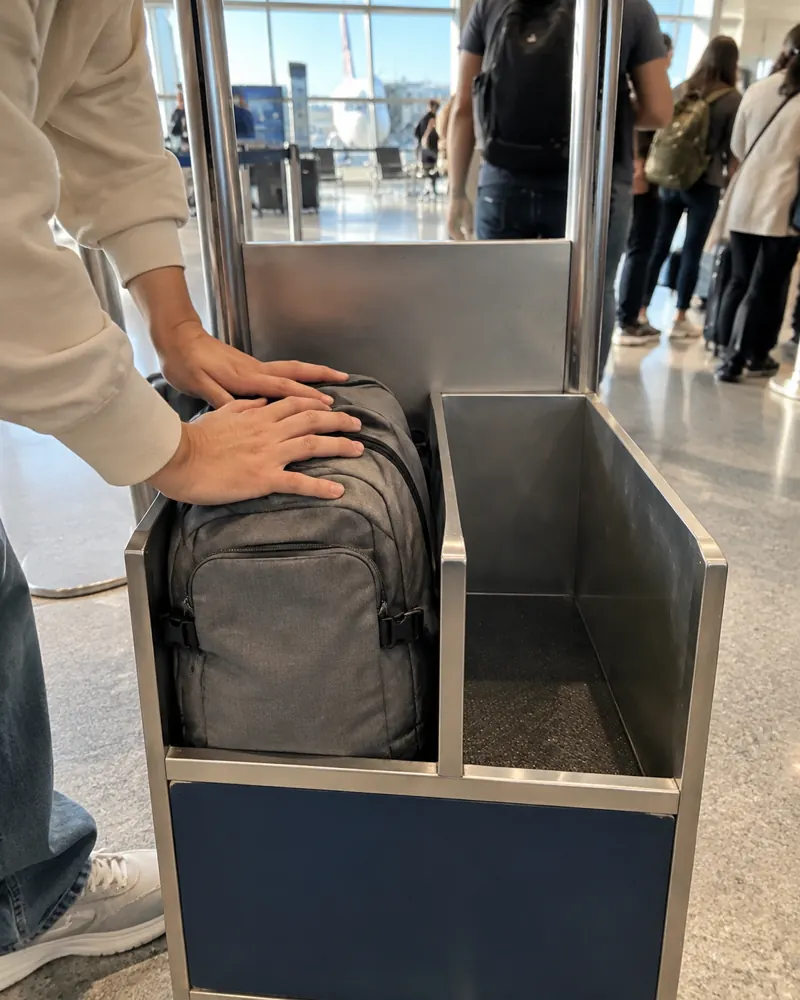
- You check in again with airline B. This is where your carry-on can get weighed or sized at the desk.
- Security again. That means your liquids rules and battery rules start over.
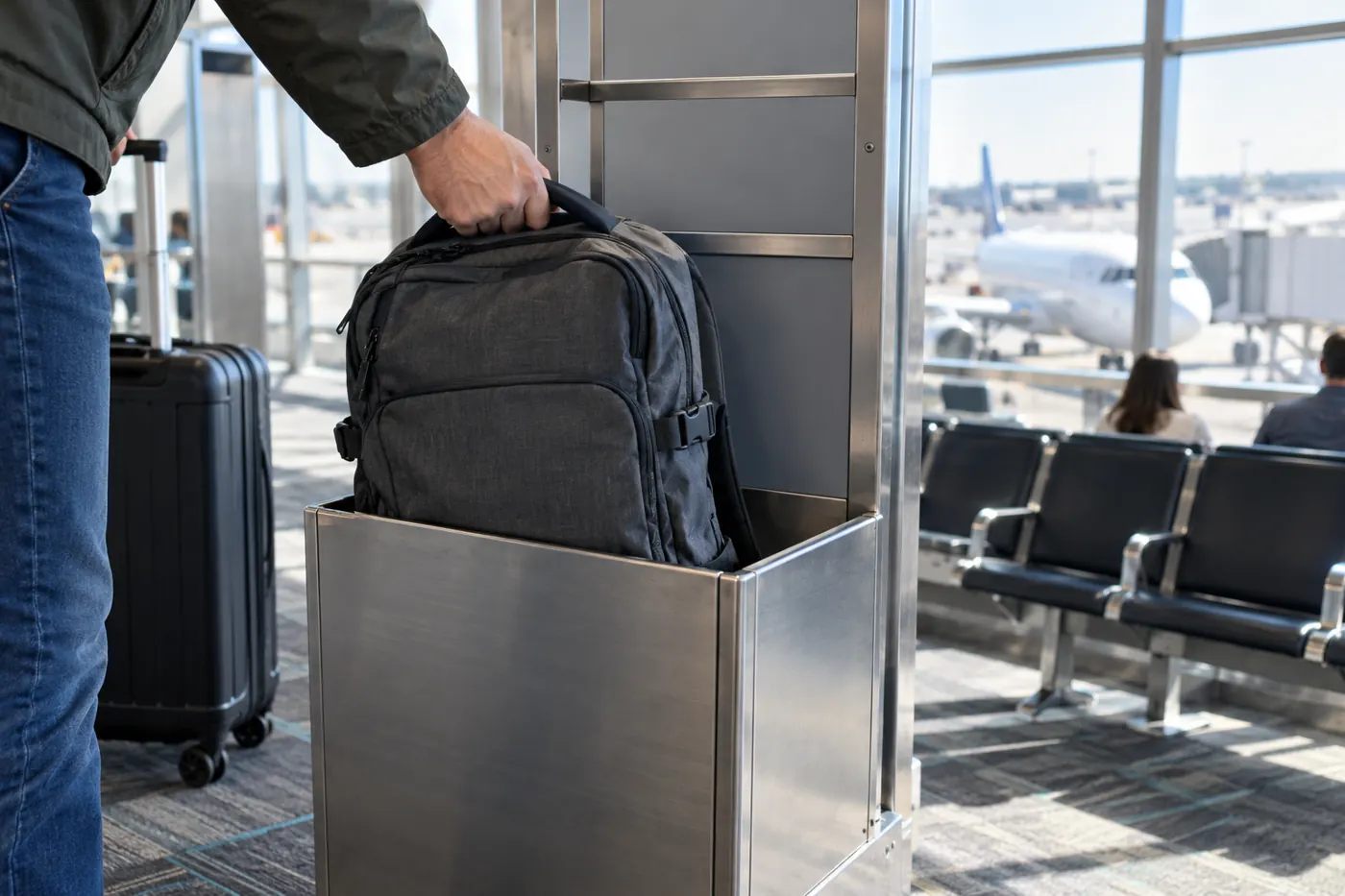
- Airline B's gate. Their sizer, their staff.
The money side is what hurts. Low-cost airlines charge less for a bag you add online in advance and more at the airport, and much more at the gate. If you only find out at the check-in desk that your bag is over, you're paying the worst price.
And the timing side: a common story in travel forums is someone who booked a self-transfer with what looked like a comfortable gap, had a delayed first flight, and reached check-in after it closed. The second airline owed them nothing. People who do this often tend to leave many hours between separate tickets, sometimes a whole overnight.
What to do: size your bag to the strictest leg
The simplest rule that works: take the smallest size and the lowest weight limit across every flight you're on, and pack to that.
That's what the trip checker is for. Add every airline on your trip and it works out one carry-on size that fits all of them, plus the lowest weight limit. Then:
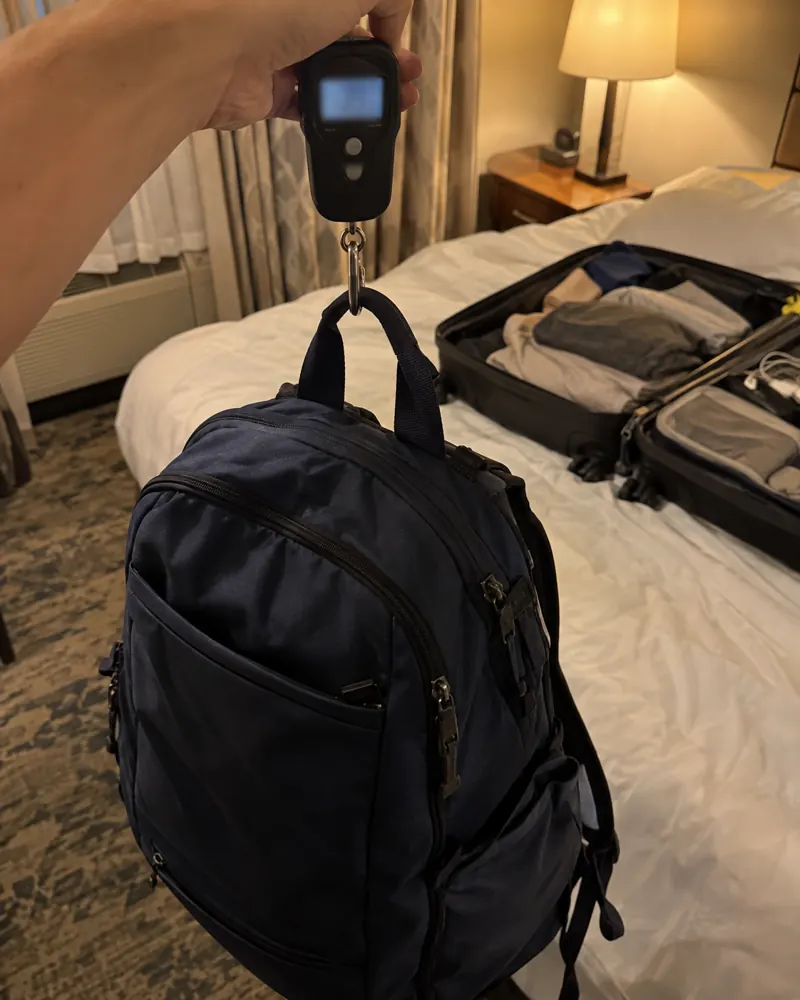
- Weigh the bag at home. If any leg has a 7 or 8 kg limit, a cheap luggage scale pays for itself on the first trip. The carry-on weight calculator helps you plan what fits.
- Count the personal item. Some airlines count your carry-on and personal item together toward one weight limit (AirAsia and VietJet do, for example). Check the weight limits by airline.
- Buy what you need on the strict leg before you fly. If the low-cost leg needs a paid overhead bag or extra weight, add it online. It's almost always cheaper than at the airport. See airlines that charge for carry-on.
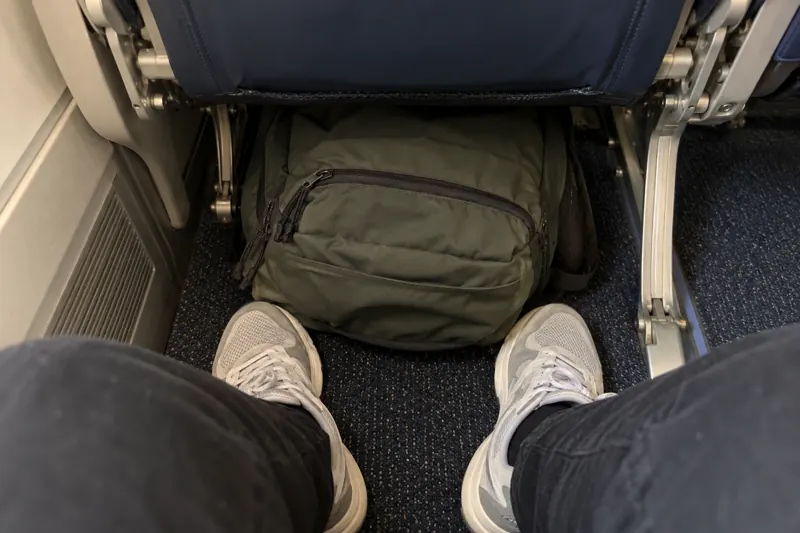
- Pick a soft bag. A soft backpack that's slightly over on one side can still squeeze into a sizer. A hard case that's a centimetre too long simply won't.
- Keep the official rules on your phone. Gate agents on a partner airline don't always know your fare details. The gate card puts the airline's limit and its source on one screen.
If you'd rather see every airline at once, the carry-on size by airline table covers all 39 airlines we track. A bag no bigger than 50 x 35 x 20 cm (19.7 x 13.8 x 7.9 in) fits every one of them.
When the bag gets checked on one leg
Sometimes the operating airline makes the decision for you: a full flight, a small regional jet, or a bag that's just over. A few things travelers often don't realize:
- On one ticket, a bag checked at the gate is often tagged to your final stop. Ask. If it's only tagged to the connection, you'll need to collect it.
- On small regional planes, a gate-checked "valet" bag may come back to you at the plane door. American's regional American Eagle flights do this for bags bigger than a personal item on planes with small bins (see American's page).
- Take your batteries out. Power banks and spare lithium batteries can't go in the hold, so pull them out before the bag leaves your hands. More on that in our power bank rules.
- Keep medicine, keys, passport and anything fragile in your personal item. Anything in the bag that gets taken away from you could go missing.
Airline pages for the usual trouble spots
Mistakes people make
- Reading only the first airline's rules. The long-haul airline's page says nothing about the 7 kg partner leg.
- Assuming a codeshare follows the airline on the ticket. At the gate, it's the operator's sizer.
- Booking a self-transfer with a tight gap, then losing time at baggage claim and check-in.
- Ignoring weight because US airlines don't weigh. Many airlines elsewhere do, and some count both bags together.
- Paying for a bag at the gate instead of adding it online the day before.
- Leaving a power bank in a bag that gets gate-checked.
Frequently asked questions
Which airline's carry-on rules apply on a codeshare flight?
For carry-on, follow the airline operating the flight, shown as "operated by" on your booking and boarding pass. Its gate staff, sizer and bin space are what you'll meet. Your fare type still comes from your ticket, so a basic fare without a carry-on doesn't gain one on a partner's flight.
Do I follow the first airline's baggage rules for the whole trip?
For checked bags on a single ticket, often yes: one airline's allowance and fees are picked for the whole journey, and in the US the rules at the start of the itinerary apply throughout. Carry-on is different. Each operating airline still enforces its own size and weight limits on its own flights.
What happens to my carry-on on separate tickets?
Each airline treats you as its own passenger. Your bag must meet airline A's rules on flight A and airline B's rules on flight B, and you'll usually go through check-in and security again in between, where the bag can be sized or weighed.
How do I find a carry-on size that works for every airline on my trip?
Add each airline to the trip checker. It gives you one bag size that fits all of them and the lowest weight limit to pack to.
Will the low-cost airline weigh my carry-on if I'm connecting from a long-haul?
It can. Being in transit doesn't exempt you. Travelers report weighing at check-in desks and boarding gates on 7 kg airlines in Asia and Australia, and on some European airlines too. Pack to the strictest limit and weigh the bag before you leave.
Do I have to pay twice for a checked bag on two airlines?
On one ticket, usually not: one set of bag fees applies to the trip. On separate tickets, yes, each airline charges its own fee for its own flight.