Is a Backpack a Personal Item? What Size Actually Fits
Yes, if it fits under the seat and the airline's size. Liters to real dimensions, the strictest airlines, and what to do if the gate says it's too big.
Short answer: yes. A backpack is the most common personal item there is. Southwest literally lists "backpack" as an example on its carry-on page, and most airlines say something similar.
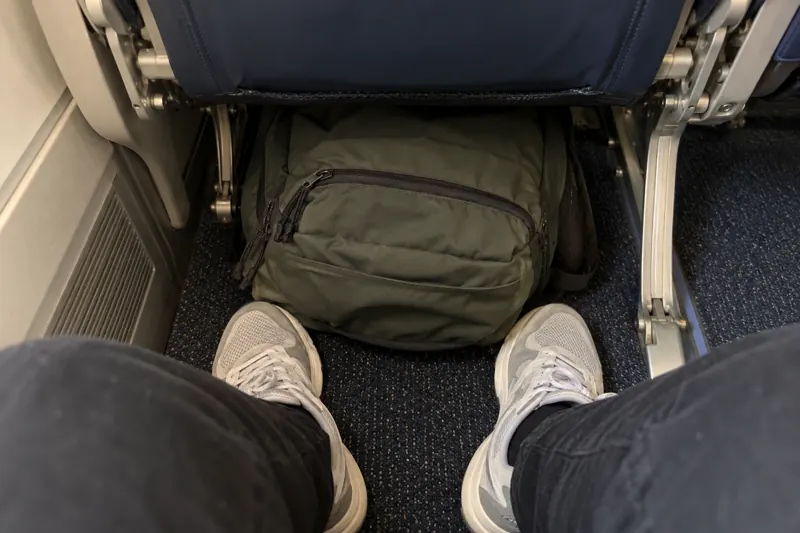
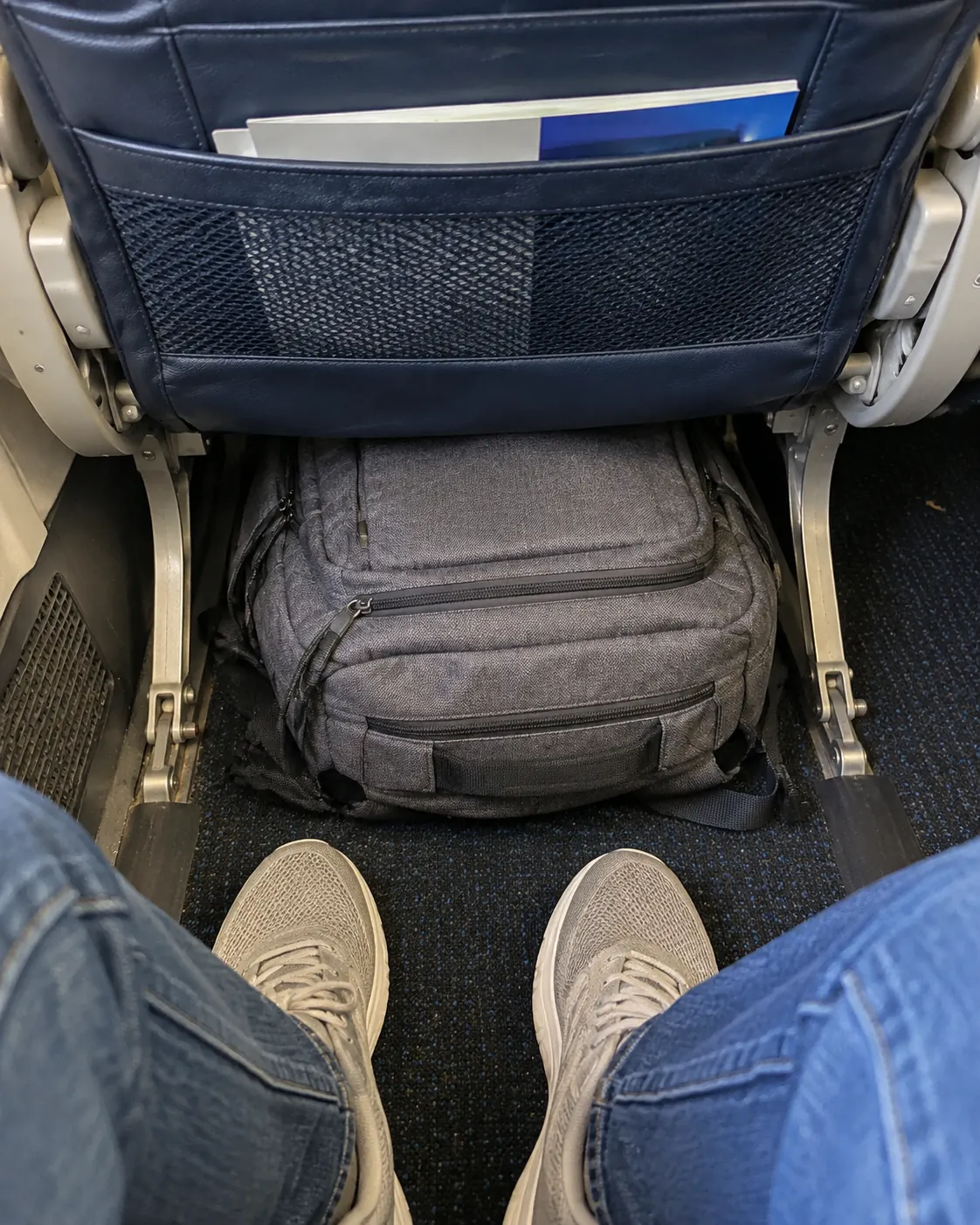
The catch is the word "fits." A backpack counts as a personal item only if it fits under the seat in front of you and, where the airline publishes one, inside its personal item size. And that's where the liters on the label stop being much help.
Short version: for US airlines, a soft 20–25 L pack that isn't stuffed usually works. For strict budget airlines in Europe, think 20 L or under. For airlines with a 10 cm depth limit (some in Asia), you're down to a slim laptop-style bag. Always check the bag's actual dimensions, not its liters.
What makes a backpack count as a personal item
Two things, and they're not quite the same:
- It fits under the seat in front of you. Every airline says this. Some, like Delta and Southwest, don't publish a size at all and stop right there.
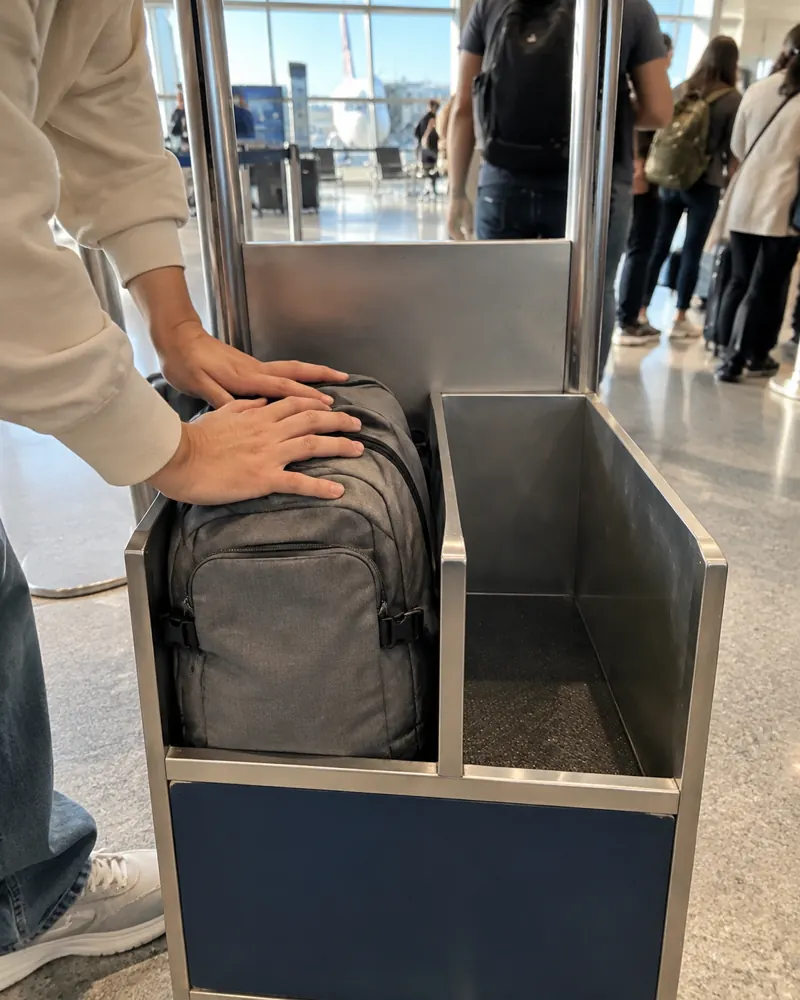
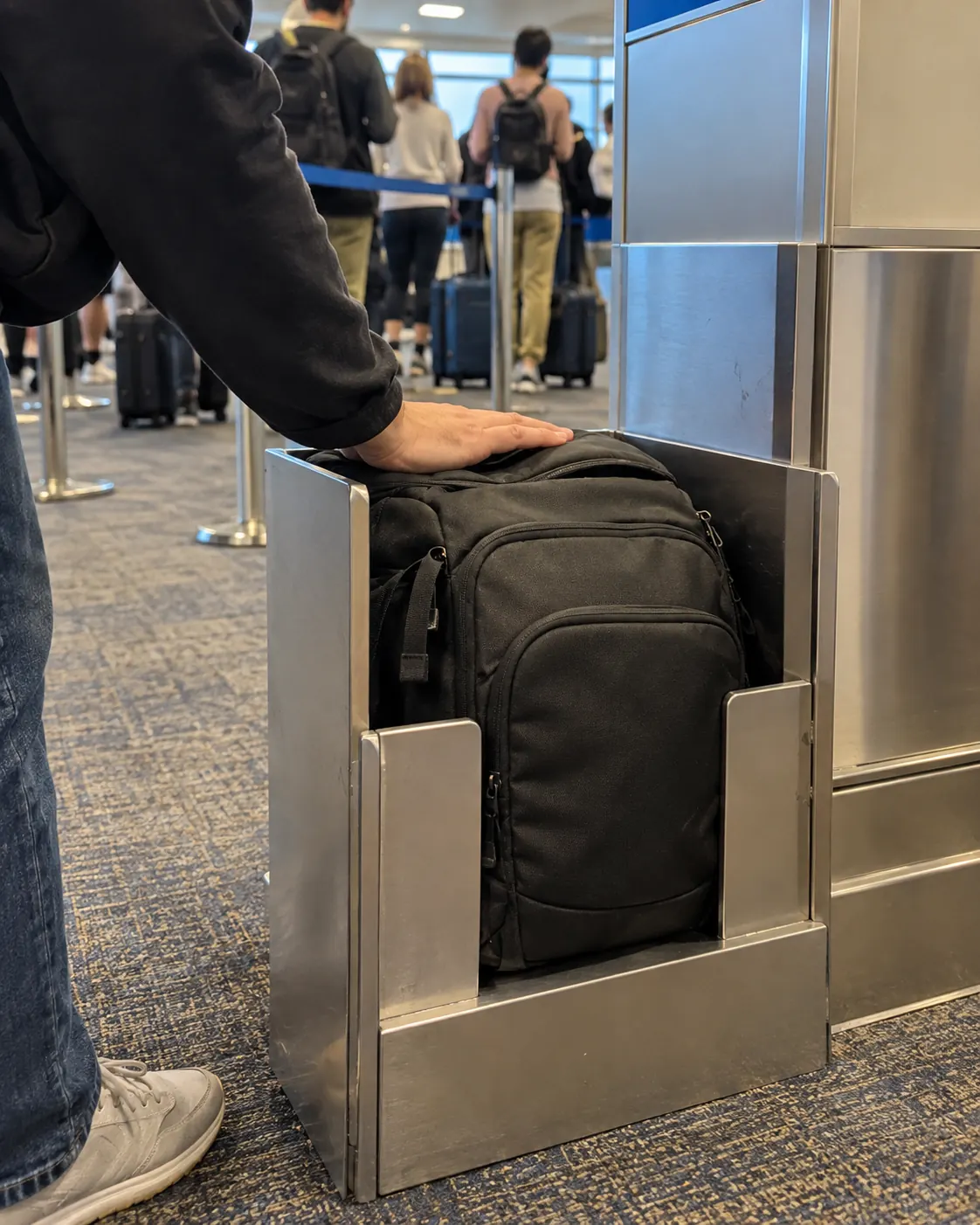
- It's within the published personal item size, if your airline has one. United, American, Ryanair, AirAsia and plenty of others give exact numbers, and on cheap fares the gate agent may put your bag in a sizer to check.
Wearing it on your back doesn't change anything. People ask this on Reddit all the time, and the replies are blunt: measure it. If it fits the published size and goes under the seat, you're fine.
Liters vs. real dimensions
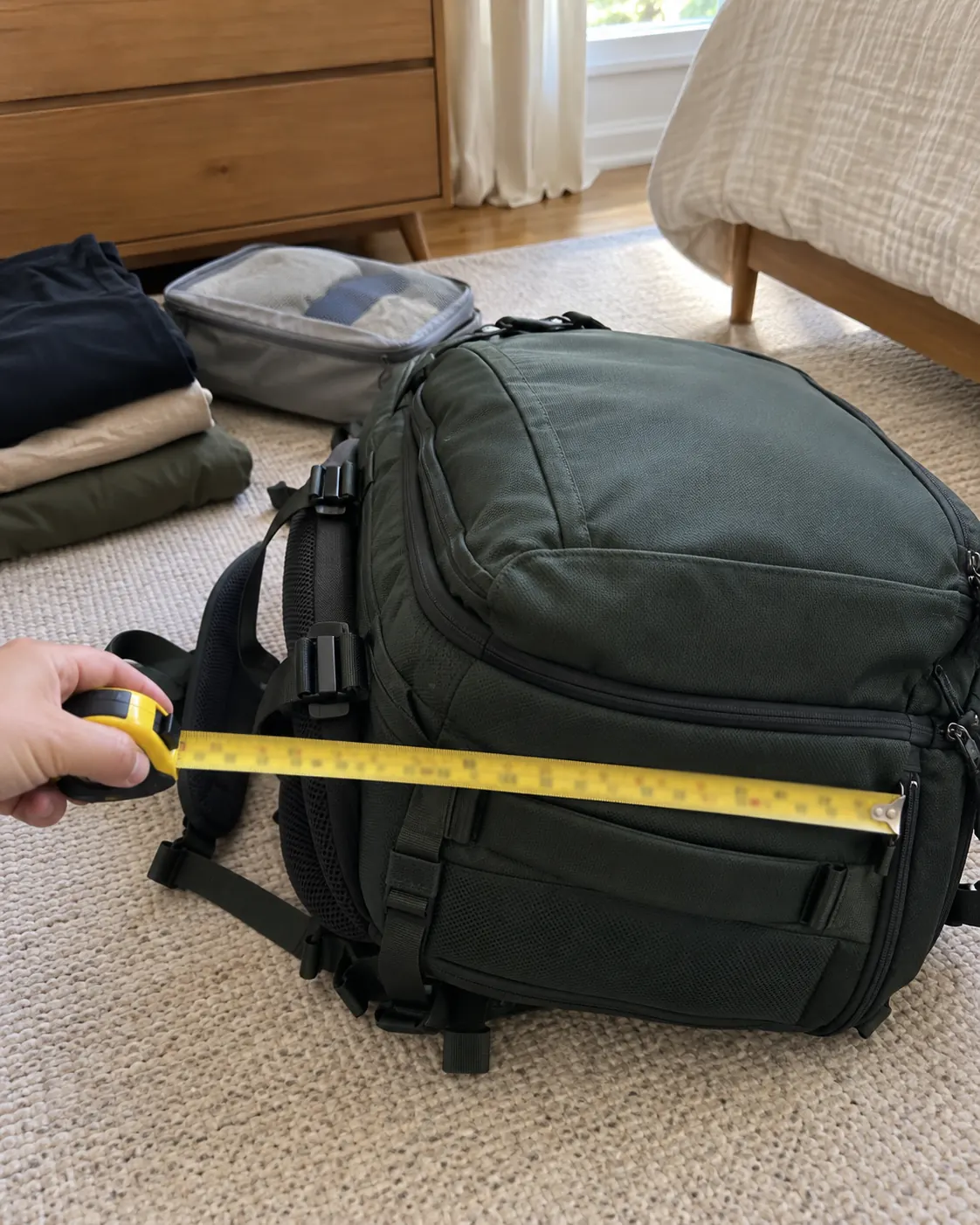
Here's the thing nobody tells you when you buy a "personal item backpack": airlines don't care about liters. They care about length, width and depth.
Liters is just volume. A tall skinny 25 L pack and a short fat 25 L pack can hold the same amount, and only one of them fits a 40 cm sizer. On top of that, brands measure liters differently. Some count every pocket, some don't. One traveler on r/onebag did the math on a popular "20 L" tote pack using the brand's own listed dimensions and got closer to 16 L.
So as a rough guide only, this is what packs of each size typically measure. Your bag will differ, so check the spec sheet or grab a tape measure:
| Label size | Typical outside size | Usually works as |
|---|---|---|
| 15 L | about 40 x 28 x 13 cm (16 x 11 x 5 in) | personal item almost anywhere |
| 20 L | about 43 x 30 x 15 cm (17 x 12 x 6 in) | personal item on most airlines, including many budget ones if not stuffed |
| 25 L | about 46 x 31 x 18 cm (18 x 12 x 7 in) | personal item on most US airlines, tight on strict budget airlines |
| 30 L | about 50 x 32 x 20 cm (20 x 12.5 x 8 in) | borderline personal item, often too tall |
| 40 L | about 55 x 35 x 23 cm (22 x 14 x 9 in) | a carry-on, not a personal item |
That 40 L row is basically the size of a standard carry-on. The Osprey Farpoint 40, for example, is listed at 55 x 35 x 23 cm. Great bag, but it goes in the overhead bin, not under the seat.
A useful trick: multiply out the airline's limit. A 40 x 30 x 20 cm box holds 24 L, a 40 x 30 x 15 cm box 18 L. Backpacks are rounded and never fill the box, which is why the onebag crowd keeps landing on "around 20 L" for budget airlines.
Which airlines are the tightest
There's no single size. For US airlines, here's what each one publishes:
| Airline | Country | Size limit | Weight | Personal item |
|---|---|---|---|---|
| United Airlines | United States | 17 x 10 x 9 in 43 x 25 x 22 cm | — | Included |
| Breeze Airways | United States | 17 x 13 x 8 in about 43 x 33 x 20 cm | — | Included |
| JetBlue | United States | 17 x 13 x 8 in 43.2 x 33 x 20.32 cm | — | Included |
| Allegiant Air | United States | 18 x 14 x 8 in 45 x 35 x 20 cm | — | Included |
| American Airlines | United States | 18 x 14 x 8 in 45 x 35 x 20 cm | — | Included |
| Frontier Airlines | United States | 18 x 14 x 8 in about 46 x 36 x 20 cm | — | Included |
| Alaska Airlines | United States | No size published Must fit under the seat | — | Included |
| Delta Air Lines | United States | No size published Must fit under the seat | — | Included |
| Southwest Airlines | United States | No size published Must fit under the seat | — | Included |
A pack no bigger than 16.9 x 9.8 x 7.9 in (43 x 25 x 20 cm) fits every US airline here that publishes a size.
The one that catches people is United: its personal item is only 10 inches wide, narrower than American or Frontier. A wide laptop backpack that sails through on other airlines can be too wide on paper for United. In practice, plenty of travelers say United only cares when the bag clearly won't go under the seat. But on Basic Economy and full flights, that's exactly when you're likely to get checked.
Canada is worth a mention too. Air Canada, WestJet and Porter cap the personal item at around 6 inches (15–16 cm) deep. One traveler on r/travel got charged at a Porter gate for a backpack they'd specifically bought to fit United's Basic Economy size. The depth is what got them.
Europe is where "personal item only" fares are everywhere, and sizes cluster around 40 x 30 x 15 or 40 x 30 x 20 cm:
| Airline | Country | Size limit | Weight | Personal item |
|---|---|---|---|---|
| Air France | France | 16 x 12 x 6 in 40 x 30 x 15 cm | — | Included |
| Lufthansa | Germany | 40 x 30 x 15 cm about 15.7 x 11.8 x 5.9 in | — | Included |
| KLM | Netherlands | 40 x 30 x 15 cm about 15.7 x 11.8 x 5.9 in | — | Included |
| Iberia | Spain | 40 x 30 x 15 cm about 15.7 x 11.8 x 5.9 in | — | Included |
| Turkish Airlines | Turkey | 40 x 30 x 15 cm about 15.7 x 11.8 x 5.9 in | 4 kg (9 lb) | Included |
| British Airways | United Kingdom | 16 x 12 x 6 in 40 x 30 x 15 cm | — | Included |
| Wizz Air | Hungary | 40 x 30 x 20 cm about 15.7 x 11.8 x 7.9 in | 10 kg (22 lb) | Included |
| Aer Lingus | Ireland | 15.5 x 11.5 x 8 in 40 x 30 x 20 cm | — | Included |
| Ryanair | Ireland | 40 x 30 x 20 cm about 15.7 x 11.8 x 7.9 in | — | Included |
| Vueling | Spain | 40 x 30 x 20 cm about 15.7 x 11.8 x 7.9 in | — | Included |
| easyJet | United Kingdom | 45 x 36 x 20 cm about 17.7 x 14.2 x 7.9 in | 15 kg (33 lb) | Included |
| Jet2 | United Kingdom | No size published Must fit under the seat | — | Included |
Asia has the smallest second-bag sizes we track. AirAsia, VietJet and Singapore Airlines allow an extra small bag of 40 x 30 x 10 cm. Ten centimeters is about 4 inches. That's a laptop sleeve, not a daypack.
| Airline | Country | Size limit | Weight | Personal item |
|---|---|---|---|---|
| AirAsia | Malaysia | 40 x 30 x 10 cm about 15.7 x 11.8 x 3.9 in | — | Included |
| Singapore Airlines | Singapore | 40 x 30 x 10 cm about 15.7 x 11.8 x 3.9 in | — | Included |
| Vietjet Air | Vietnam | 40 x 30 x 10 cm about 15.7 x 11.8 x 3.9 in | — | Included |
| Vietnam Airlines | Vietnam | 40 x 30 x 15 cm about 15.7 x 11.8 x 5.9 in | — | Included |
| ANA (All Nippon Airways) | Japan | 40 x 30 x 20 cm about 15.7 x 11.8 x 7.9 in | — | Included |
| Japan Airlines (JAL) | Japan | No size published Must fit under the seat | — | Included |
But here's the twist with Asian airlines: many of them care more about weight than size. AirAsia and VietJet count your small bag toward a combined 7 kg. If that's your trip, read our guide to the 7 kg carry-on limit too.
Want the whole list in one place? The personal item size chart has every airline we track.
Soft vs. rigid, and the overfilled pack problem
Soft packs are forgiving. If your pack is a centimeter over on paper but only half full, you can usually squash it into a sizer or under a seat. That's the single most repeated piece of advice in onebag threads: don't stuff it to the brim.
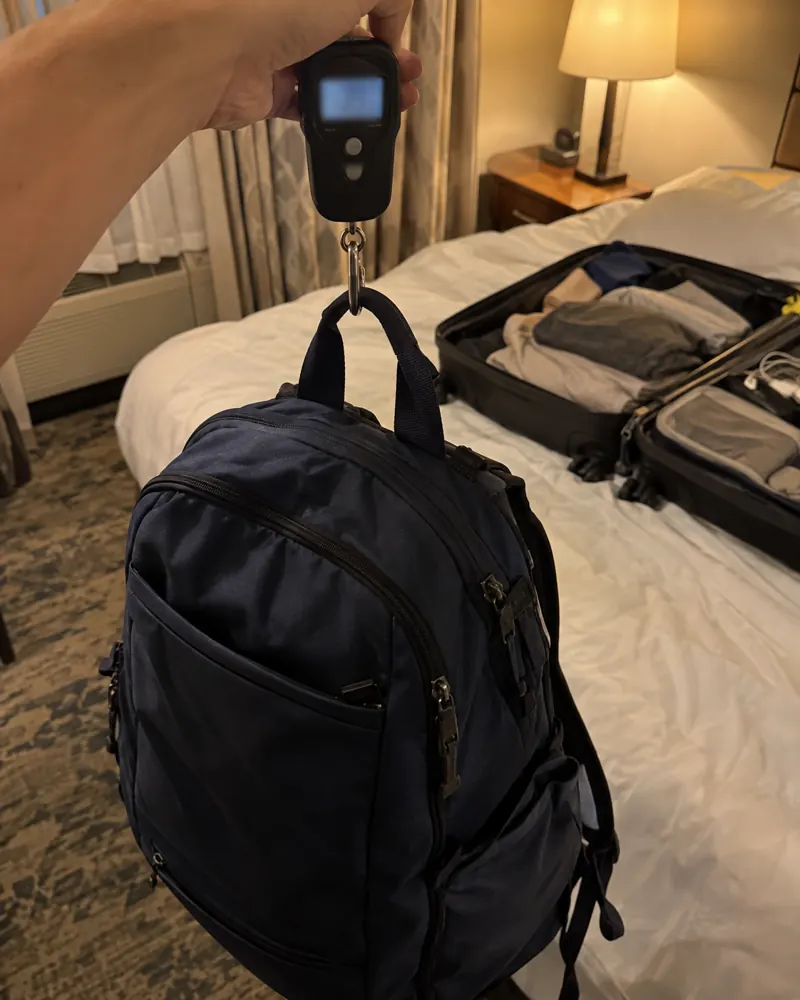
The flip side: a soft pack packed rock-hard behaves like a rigid bag. Now it's as big as its fully packed dimensions, maybe bigger, because it bulges.
A few things that make a pack measure bigger than you think:
- Water bottles in the side pockets. They add width. Someone on a Ryanair flight said they had to pull theirs out to get the bag under an aisle seat.
- A stuffed front pocket. It adds depth, which is the dimension Canadian and Asian airlines are strictest on.
- Hip belts and frames. Hiking-style packs with a stiff back panel can't squash at all.
- Things clipped to the outside. Shoes, a neck pillow, a water bottle on a carabiner all count.
Rigid "underseat" bags, like the Travelpro rolling underseat bags, are the opposite: their listed size is their real size, wheels included. Easy to predict, impossible to squeeze.
Not every seat has the same space underneath
This one surprises people. The space under the seat in front of you isn't the same everywhere on the plane.
- Aisle seats often have less room. Travelers on both United and Ryanair say their pack fits fine under a middle seat but not under the aisle one.
- Some seats have an equipment box under them (it's for the in-flight entertainment), which eats a chunk of the space.
- Bulkhead and exit rows have nothing in front of you, so your bag goes in the overhead bin for takeoff. Qantas spells this out: in an exit row or at a bulkhead, your underseat bag goes up top.
- Small regional planes shrink everything. Qantas, for example, says small wheelie bags don't fit overhead on its Dash 8 Q400 and get collected at boarding.
If your pack is borderline, a middle or window seat on a big jet is your friend.
Using a backpack as your carry-on (the overhead bin fight)
Plenty of people travel with one bag, and it's a backpack. That's allowed. If your fare includes a carry-on, your backpack can be that carry-on, and it can go in the overhead bin.
The problem is crew don't always see it that way. Threads on r/SouthwestAirlines and r/unitedairlines are full of the same story: a flight attendant sees a backpack in the bin, assumes it's a personal item, and asks you to move it under your seat to make room for roller bags. People who packed light end up with less legroom than the person who brought two bags.
What people do about it:
- Bring a small second item for under the seat, like a sling, a tote or a headphone case. Then it's obvious the backpack is your carry-on and the small thing is your personal item. This is the most common tip by far.
- Put the pack under the seat first, move it up later. Some folks say they stow it underneath at boarding and move it to the bin once everyone's seated and there's still space.
- Be polite. Explain it's your only bag. The crew still has the final say.
On Basic Economy or other personal-item-only fares, it's different: your backpack is the personal item, so it goes under the seat. Full stop.
One more thing travelers have noticed lately: some Southwest gate agents have started using the personal item sizer at boarding. Southwest's carry-on page doesn't publish a personal item size, only that it must fit under the seat, so expect agents to judge by eye and by the sizer.
What to do if you're told it's too big
It happens. Stay calm and try these in order:
- Squash it. Tighten every compression strap, pull out water bottles and anything bulky in the front pocket, then try the sizer again.
- Wear the bulk. Put on the jacket or sweater that's eating space. A puffy stuffed into a neck pillow cover is a classic onebag move.
- Show the rule. If you're sure your bag is within the airline's published size, have the official limit ready on your phone. Our gate card shows your airline's limit and its source page in one screen.
- Ask about checking it. If it really doesn't fit, it'll be checked or tagged. On cheap fares there's usually a fee, and it's normally higher at the gate than online.
- Pull out the important stuff first. Laptop, passport, meds, and especially power banks and spare batteries, which generally can't go in the hold. Qantas, for one, says power banks are prohibited in checked bags.
More on fees and gate checks in what happens when your carry-on is too big at the gate.
Mistakes people make
- Buying by liters. A "28 L" pack can be any shape. Check the dimensions against your airline.
- Measuring it empty. Measure it packed, the way you'll carry it to the airport.
- Forgetting the depth. Most bags fail on the depth limit, especially in Canada and Asia.
- Trusting one lenient flight. A pack that got waved through once can get stopped on a full Basic Economy flight.
- Picking a 40 L pack as a personal item. That's a carry-on.
- Booking an aisle seat with a borderline pack. Less space under there.
Check your backpack
Type in your backpack's packed measurements and choose "Personal item" to see which airlines accept it:
Will your bag fit?
Measure with wheels, handles and pockets included. The order of the sides doesn't matter.
If you're flying more than one airline on a trip, the trip checker finds the biggest bag that fits all of them. And for ideas on what fits the strictest sizes, browse our bag pages or the fit table.
Frequently asked questions
Is a backpack considered a personal item?
Yes, as long as it fits under the seat in front of you and within your airline's published personal item size. Most airlines list backpacks as a typical personal item. A large backpack that only fits in the overhead bin counts as your carry-on instead.
What size backpack counts as a personal item?
It depends on the airline. Many US airlines allow around 18 x 14 x 8 inches, United only 17 x 10 x 9 inches, and many European budget airlines about 40 x 30 x 20 cm. In liters, a soft 20–25 L pack usually works in the US, and around 20 L or less for strict budget airlines.
Is a 30 L backpack a personal item?
Sometimes, but it's borderline. A typical 30 L pack is around 50 cm (20 in) tall, which is over most published personal item sizes. If it's soft and not fully packed, it may still fit under the seat on airlines that don't publish a size. Check the dimensions first.
Is a 40 L backpack a personal item?
No. A 40 L travel pack is roughly 55 x 35 x 23 cm (22 x 14 x 9 in), which is carry-on size. It goes in the overhead bin, so you'll need a fare that includes a carry-on.
Can I put my backpack in the overhead bin?
Yes, if it's your carry-on and your fare includes one. Crew may ask you to move it under the seat when bins are full. Carrying a small second item for under the seat makes it clear the backpack is your carry-on.