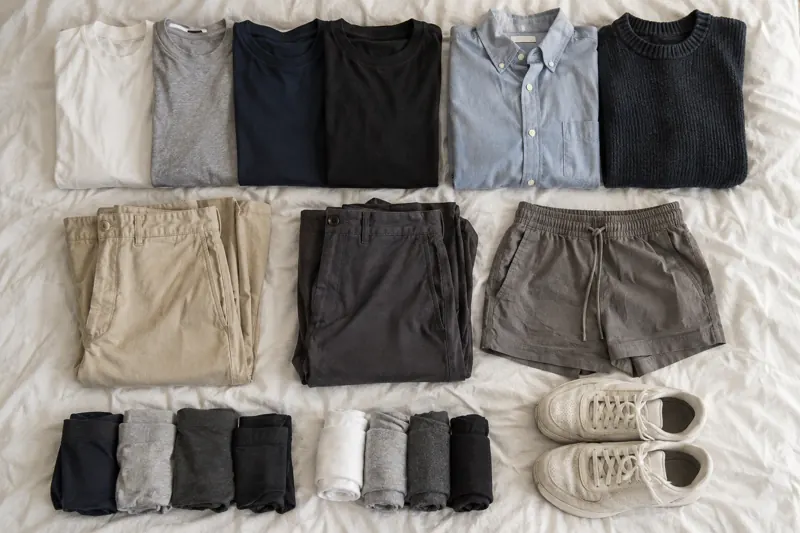
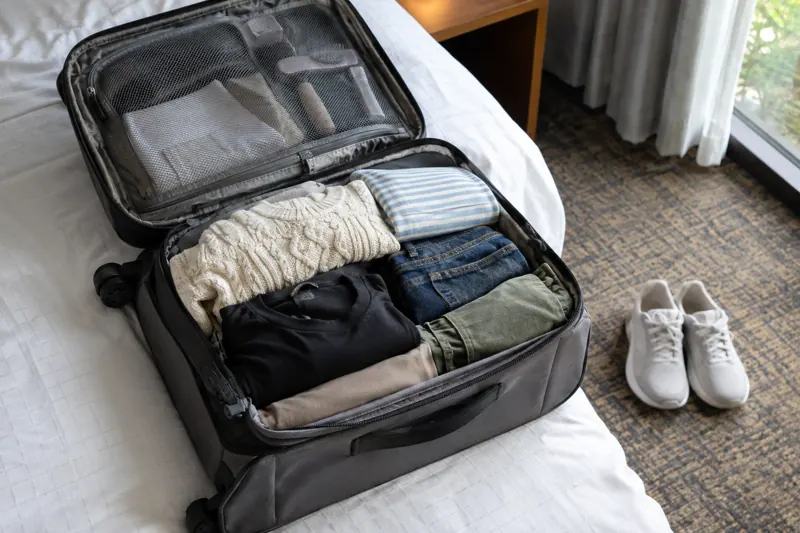
How to Pack for Hot and Cold Weather
Pack for hot and cold weather in one carry-on with a shared wardrobe, an outfit matrix, a sample list, and a plan for bulky layers between stops.
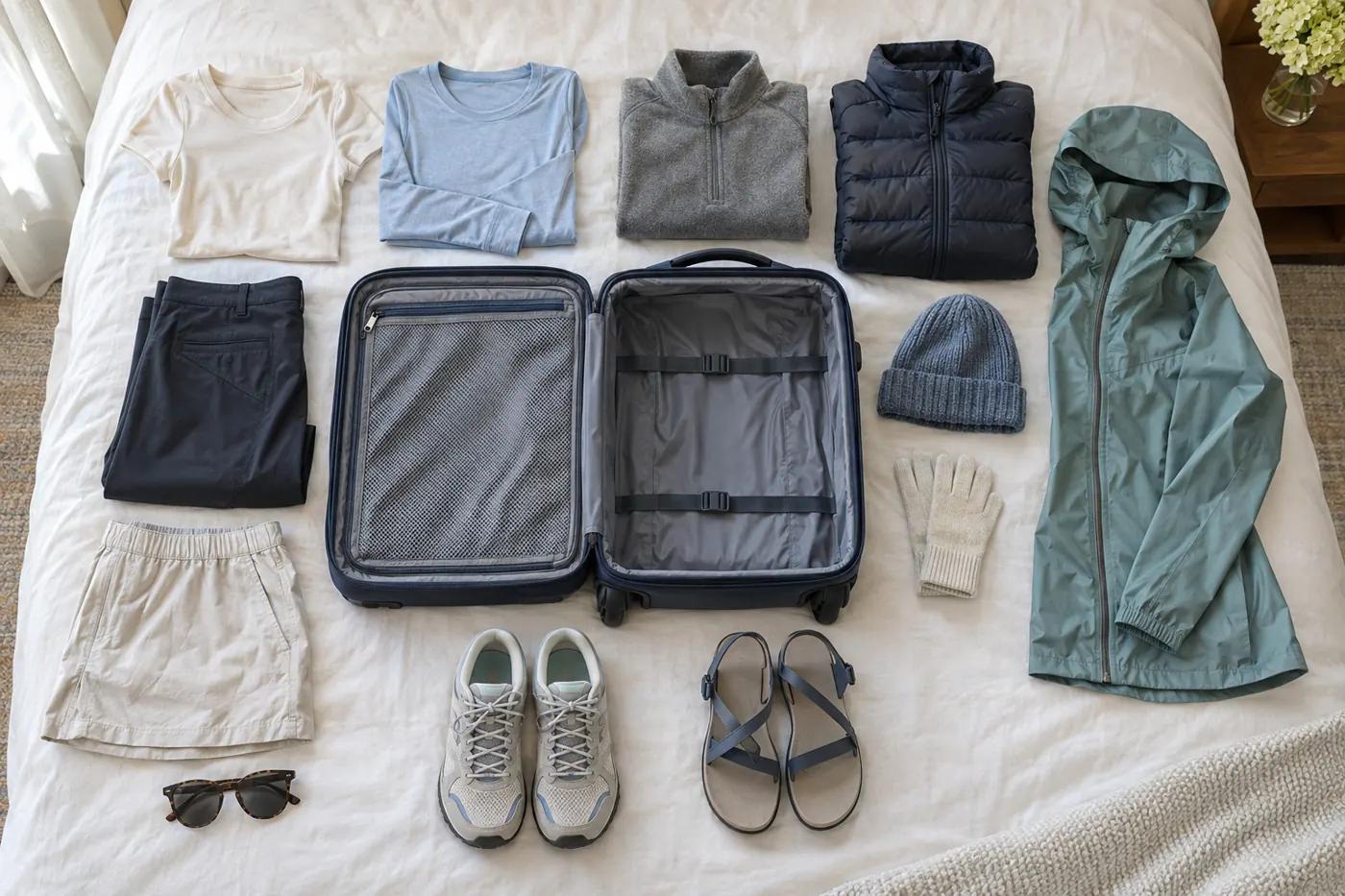
A warm beach stop and a cold city stop can make one trip look like two packing lists. The problem gets worse when you add a spare sweater, a second jacket and shoes for every possible forecast.
Packing for multiple climates works better when you start with the clothes that serve both parts of the trip. Then add the specific warmth, rain protection and footwear your itinerary needs. The useful question is not just "Can I layer this?" It is "What will I actually wear together on each part of the trip?"
Quick answer: Build one everyday wardrobe, add suitable warm and weather-protective layers, and plan outfits for your hottest day, coldest outing and wettest transfer. Count clothes around your laundry gaps. Test the complete bag with the warm layers packed inside, including the clothes you expect to wear on the first flight.
This guide focuses on everyday travel and sightseeing. A ski day, prolonged exposure to freezing weather or a remote hike needs its own appropriate equipment plan; a compact city wardrobe is not a substitute.
Start with the route, not another jacket
Write down your stops in travel order. A trip that goes cold, then warm has a different storage problem from one that alternates between the two every few days.
For each stop, record:
- The expected conditions when you will be outside, including mornings and evenings.
- Whether rain, wind or snow changes the clothing and footwear you need.
- Your activities and how long you expect to spend outdoors.
- Your next realistic laundry opportunity, including drying time.
- Whether you will need those same cold-weather items later in the trip.
Use local forecasts close to departure and update the plan as you travel. A familiar city name or a daytime high does not tell you what an early transfer or an exposed excursion will feel like.
Here is a planning example, not a forecast for a particular destination:
| Part of the trip | What you will be doing | What the packing plan must solve |
|---|---|---|
| Cool, rainy city stop | Walking between indoor visits | Clothes that layer, suitable rain protection and footwear |
| Colder evening outing | Spending longer outside with less movement | Enough insulation and appropriate accessories for that outing |
| Warm, humid stop | Sightseeing and frequent clothing changes | Comfortable light outfits and a workable washing plan |
| Transfer between stops | Airports, trains and a change of weather | Somewhere to pack the layers you remove |
If an item has no use in this table or in a confirmed activity, pause before adding it. If an essential item does not fit, change the luggage or activity plan instead of leaving yourself underprepared.
Build one wardrobe with separate jobs
Pick everyday tops and bottoms that you like wearing together. They do not all have to be beige or black; they need to make outfits you will actually use. A top that works with both your trousers and your warm-weather bottom is more useful than a second complete outfit for one lunch.
Then give each additional layer a job. The National Park Service's layering guidance separates moisture management near the skin, insulation and protection from the elements. That distinction helps you avoid packing three items that perform the same task while forgetting another task entirely.
- Next to the skin: everyday tops and, when needed, suitable thermal layers.
- For warmth: a fleece, sweater or insulated jacket appropriate to the conditions.
- For weather: a shell appropriate to the rain and wind you expect.
A thin rain shell and an insulated jacket do different jobs. A fleece and an insulated jacket can also both earn a place when you genuinely need their combined warmth. The point is to choose deliberately, not to declare that every traveler needs exactly three garments.
Try the combination on before departure. Zip the outer layer over the others, move your arms, sit down and wear the backpack. A jacket that fits over a T-shirt may not fit comfortably over your warmest outfit.
REI's layering guide also notes that activity and individual temperature preferences affect what works. There is no reliable promise that one generic "packable jacket" covers every cold destination. Use clothing you understand, and choose protection for the actual outing.
Make an outfit matrix for hot, cool and wet days
Lay the clothes on your bed and build these combinations from the same pieces. These are starting points to test against your itinerary, not temperature ratings.
| Situation | Shared clothes | What changes |
|---|---|---|
| Warm, dry sightseeing | Light everyday top | Warm-weather bottom, suitable shoes and sun protection |
| Cooler city day | The same top with long trousers | Add the warm layer you need |
| Cool, windy or rainy day | Everyday outfit with suitable warmth | Add weather protection and choose footwear for wet conditions |
| Colder evening outside | Suitable next-to-skin layers and long bottoms | Add the insulation, accessories and footwear that outing requires |
| Travel day into warmer weather | Comfortable everyday outfit | Keep space in the bag for the layers you take off |
Photograph the combinations or note them in your travel packing list. This is more useful than counting how many potential outfits five tops and three bottoms could theoretically produce.
Pay attention to the weakest combination. If the cold outfit only works while you are walking quickly, it may not suit a long outdoor queue. If your warm outfit depends on a top that is still drying, your laundry plan needs a buffer.
A sample carry-on list for a mixed-weather trip
The following is an illustrative starting list for a trip with everyday sightseeing, warm and cool stops, and laundry during the trip. Counts include the clothes worn while traveling. Adjust them for your own washing interval, activities and clothing needs; this is not a guarantee that everything fits a particular bag.
| Item | Starting amount | How to decide |
|---|---|---|
| Everyday tops | 4 | Choose pieces that work alone and under your warm layer |
| Lightweight long-sleeve top or shirt | 1 | Keep it only if it adds useful coverage or an outfit option |
| Long bottoms | 2 | One can be worn while the other is washing or drying |
| Warm-weather bottom | 1 | Shorts, a skirt or another option you actually wear |
| Fleece, sweater or cardigan | 1 | Match it to your everyday outfits and outer layer |
| Insulated jacket | If required | Decide from the cold part of the trip, not its marketing name |
| Rain or wind protection | 1 suitable layer | Choose for expected conditions, rather than assuming any thin jacket will do |
| Thermal top and bottoms | If required | Add only when the cold-weather plan calls for them |
| Underwear and socks | For the washing gap, plus a buffer | Count changes and allow time for items to dry |
| Sleepwear | 1 set | Make sure it is available when other clothes are washing |
| Walking footwear | 1 suitable pair | Test it for the surfaces and weather you expect |
| Second footwear option | Only for a distinct need | For example, suitable sandals for the warm portion |
| Hat, gloves and neck coverage | As conditions require | Treat these as part of the cold outfit |
| Swimwear or activity clothing | For confirmed plans | Avoid a separate wardrobe for an outing you may not do |
For clothing quantities by trip length, use our one- and two-week carry-on guide. Here, the extra decision is how those clothes work across the route.
Let laundry decide the repeats
A two-week itinerary does not automatically require twice the clothes of a one-week itinerary. What matters is the longest stretch between practical washing opportunities.
For example, if you plan one fresh pair of socks per day and can wash after day five, five pairs leave no margin for drying or a missed laundry stop. You may choose an extra pair, wash earlier, or use a service with a turnaround that works for you. That is a planning calculation, not a fixed rule for everyone.
Warm, active days may mean more changes than cool indoor days. Do not base the whole trip on rewearing a shirt you know you will want to wash after every use. Test your chosen fabrics at home, including how they dry in the conditions you can reasonably provide.
Our travel laundry guide covers washing options. Keep your outfit plan practical: you still need something comfortable to wear while laundry is in progress.
Solve shoes before adding more clothes
Start with the footwear needed for your hardest confirmed activity or weather condition. Then see what else that pair can comfortably do.
If your main pair handles normal walking across both stops, a slim second pair may be enough for a genuinely different use. If the cold section requires winter footwear, allow for that bulk from the beginning. Do not assume light city sneakers will cover snow, ice or every hiking route.
Give each proposed pair a sentence: "I need these for ___, and my other pair cannot do that because ___." Two pairs that fill the same blank are worth reconsidering.
Our carry-on shoe guide helps with that decision. Also check your shoes with the socks you intend to wear; adding thick socks to a snug shoe can change the fit.
Plan where the warm layers go after the cold stop
Wearing a coat on the first flight does not make it disappear during the warm half of the trip. Do a second packing trial with the coat, gloves and any other removable layers inside the bag.
Three arrangements are worth considering:
- Carry the layers throughout. This is straightforward when you will need them again or they fit comfortably in your luggage.
- Arrange storage or borrowing. If you return to the same accommodation or visit someone who can help, confirm availability, collection timing and suitable sizes before depending on it.
- Arrange a rental or shipment for a specific segment. Check actual availability, sizing, dates, total cost and delivery or collection arrangements. Do not assume specialist clothing can be rented everywhere or that a parcel will arrive before you do.
If you intend to buy clothing during the trip, establish where and how you will find suitable items. Availability and fit are not guaranteed. Keep the clothing needed for your arrival with you.
See flying with a winter coat for handling the coat in transit, and check your airline's rules for what counts toward your allowance.
Test the full bag, including the unglamorous items
Clothing is only one part of the load. Add toiletries, chargers, medicines, travel documents and everything else before deciding the capsule fits. Our carry-on toiletries guide can help reduce container bulk without abandoning your routine.
Use any suitable organizers you already own. Packing cubes and compression bags can help with organization or bulk, but compressing clothes does not remove their weight. Keep the next layer you will need accessible instead of burying it in a tightly packed cube.
Weigh and measure the packed bag, then check the allowance for each flight in our trip checker. If weight is the constraint, the carry-on weight calculator helps you see where it goes.
If you need a handheld scale, the option below is listed by Etekcity with a capacity of 50 kg / 110 lb. That is its measuring capacity, not an airline allowance or a claim that we have tested its accuracy. A suitable scale you already have may be enough.
Final check before you leave
- You have a workable outfit for the warmest, coldest and wettest parts of your actual itinerary.
- The layers fit together comfortably, and footwear suits the planned activities.
- Clothing quantities cover the longest washing gap, including drying time.
- Warm layers fit in the luggage when you are not wearing them.
- Any rental, storage, borrowing or shipping arrangement is confirmed.
- The complete luggage meets the relevant flight limits and still closes without a struggle.
Save that tested list for the trip. Afterward, note which items you used and which stayed in the bag; that makes the next mixed-weather packing decision much easier.
Frequently asked questions
Can I pack for hot and cold weather in one carry-on?
Often, if your activities and required clothing fit the bag's size and weight limits. Use a shared everyday wardrobe, add suitable protection for the cold and wet portions, and test the bag with all removable layers inside. Specialist activities or severe conditions may require a different luggage plan.
Should I pack two separate travel wardrobes?
Start with shared tops and bottoms, then add items for needs they cannot cover. Two complete wardrobes can duplicate basics unnecessarily. Some genuinely specialized clothing may still be necessary; assess the actual activity before cutting it.
Is a fleece or a puffer jacket better for a mixed-climate trip?
Neither is universally better. Choose the warmth, fit and weather suitability your itinerary needs. You may use one or both for different jobs. Test the full outfit with your outer layer rather than choosing solely from how small an item packs.
What should I do with my winter coat in a hot country?
Plan to carry and pack it, or confirm a specific storage, borrowing, rental or shipping arrangement for the relevant segment. Wearing it on the first flight does not solve its storage later. Keep it if you will need it again and cannot reliably replace it.
Does a two-week trip need twice as many clothes?
Not automatically. Plan around your longest practical laundry gap, expected changes and drying time. A warm, active stretch without washing may need more repeats than a cool city stay with easy laundry, even if it is shorter.
Research notes
Questions about turning layering advice into actual outfits, carrying warm clothing into the next climate, and finding suitable replacement clothing helped shape this guide. The threads below are individual experiences, not a representative survey, a temperature guarantee or a product test. Our sample list and outfit matrix are planning examples. Official layering guidance and manufacturer specifications are linked beside the relevant statements above.